There is a stretch of Nepal that stayed closed to outsiders until 1992, and even now, only a small number of travellers make their way there each year. The Upper Mustang trek carries you through a landscape shaped by wind rather than rain, past monasteries older than most nations, and eventually into a walled city that closed its gates to outsiders for centuries. sits behind the Annapurna range in a place so dry that people call it the desert of Nepal.
The moment you decide to walk through it, you begin a journey that feels closer to stepping into an old Tibetan story than to an ordinary trek. A trekker who walked this route a few years ago described it as the feeling of turning a page in a very old book that somehow still smells like fresh ink. That sense of discovery runs through nearly every day of the trip.
Setting Out from Kathmandu
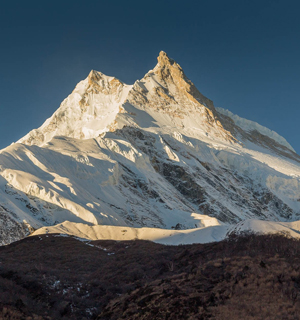
The trek begins gently, with a long drive toward Pokhara that follows the curves of the Prithvi Highway for most of the day. Rivers appear and disappear beside the road, and every so often, a gap in the hills offers a glimpse of Manaslu or Ganesh Himal standing quietly in the distance.
The drive lasts around six or seven hours, and reaching Pokhara in the evening feels like arriving at the calm edge of something much larger.
Rising Into the Mountains
The following morning brings a short flight to Jomsom, and this leg of the journey alone tends to leave a lasting impression. The plane passes above what many consider the deepest gorge in the world, and the Kali Gandaki River below looks almost impossibly thin from that height.
Once you land, the trail begins immediately along the riverbank, leading you after a few hours to Kagbeni, a village that seems to sit exactly on the line between ordinary Nepal and something older and quieter.
Passing Through the Gate
At Kagbeni, your restricted area permit is checked and stamped, and from that point forward, the trail belongs to a much smaller world. Few travellers pass this way each year, so the villages you enter, places like Tangbe and Chhusang, tend to carry an unhurried rhythm that feels almost private.
Orchards line the paths in places, and the cliffs around them shift colour slowly as the sun moves. After several hours of walking, the trail brings you to Chele, where evenings arrive with a chill that seems to settle in all at once.
Into the Cold Desert
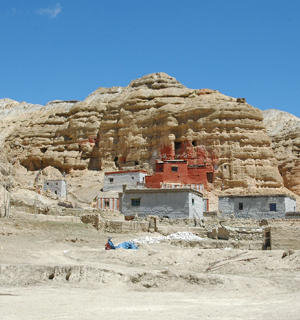
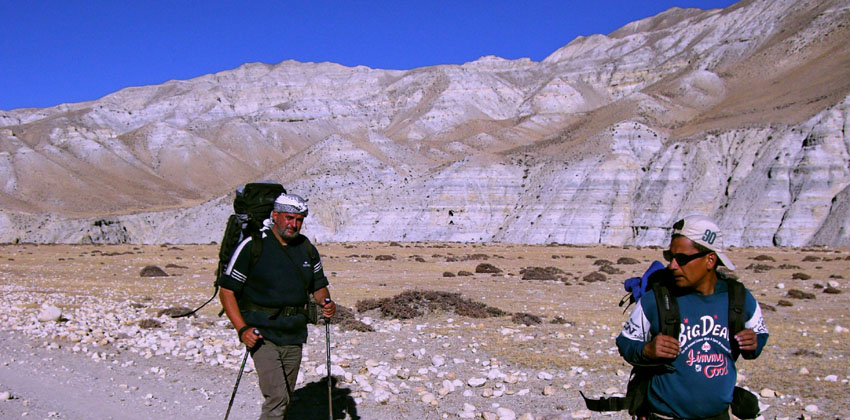
The next stretch of trail climbs over two passes, Dajori La and Yamda La, and here the terrain becomes more like a painting than a path. Layers of red and gold rock rise around you, carved by centuries of wind into shapes that shift depending on the light.
Somewhere along the way, small gompas appear tucked into the hillside, their prayer flags fluttering steadily against a sky that rarely holds a cloud. By the time you reach Geling after a long day of walking, the silence of the desert feels earned rather than simply arrived at.
Toward the Old Capital
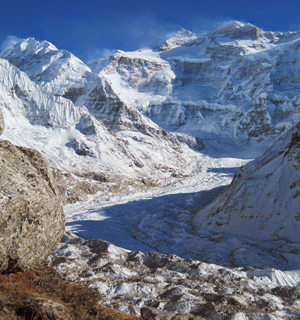
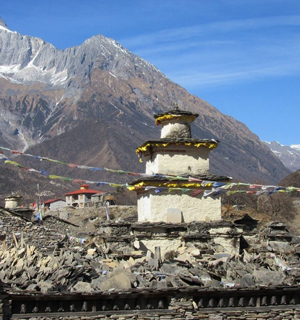
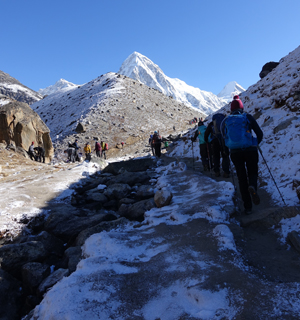
Leaving Geling, the trail rises past four thousand meters, and on a clear day, the full sweep of the Annapurna range opens up behind you. The path leads past what locals often call the longest mani wall in the region, each stone carved by hand and left behind by travellers who walked this same route long before any of us.
Eventually, the trail descends into Charang, a village that once served as the medieval seat of power for the kingdom of Lo, and an old fort still watches quietly over the rooftops below it.
The Walls Appear
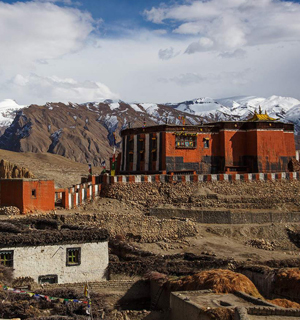
The walk toward Lo Manthang crosses Lo La Pass, and near the top of that climb, the walled city comes into view for the first time, rising out of the desert like something built to be seen from exactly this angle. Many trekkers stop walking for a moment without quite meaning to.
The descent into the city takes a few more hours, and by evening you find yourself resting behind walls that have guarded this place since the fifteenth century, largely unchanged despite everything happening beyond them.
A Day Among Monasteries and Caves
You spend a full day exploring Lo Manthang, moving through narrow streets toward Jampa Lhakhang and Thubchen Gompa, where painted walls hold centuries of careful devotion beneath layers of dust. A short walk beyond the city leads to the sky caves of Chhoser, thousands of chambers cut directly into the cliffs, some used long ago for burial and others simply for quiet reflection.
Travellers who happen to visit in May might catch the Tiji festival, three days of masked dancing meant to push away old troubles from the land. A local elder once summed up the festival gently, saying the dances remind the village every year that peace takes effort to protect, not luck to keep.
Walking Back Through the Desert
The return journey retraces much of the same ground, passing again through Ghemi and Samar before reaching Kagbeni once more. Yet the trail somehow feels new the second time, perhaps because the light falls differently in the afternoon, or perhaps because your eyes have learned how to read this landscape by now.
The red cliffs of the plateau seem to hold onto the sunlight a little longer on this stretch, and many trekkers find themselves pausing more often, simply to look a while longer before moving on.
Returning to Softer Air
A short flight carries you from Jomsom back to Pokhara, and almost immediately the air feels heavier and warmer against your skin. Afternoons here often drift by on Phewa Lake or along the quiet path toward Davis Falls, giving the body a gentle way to ease out of the trek before the final stretch home.
The Long Drive Back
The last full day returns you to Kathmandu by road, and there is usually a kind of quiet conversation that fills the van somewhere along the way, trekkers comparing memories of passes and villages that already feel slightly unreal. A farewell dinner closes the trip that evening, a small and familiar way of marking the end of something that rarely feels finished so quickly.
Small Details Takeaways
Upper Mustang sits in the rain shadow behind the Annapurna range, so it stays dry even when the rest of Nepal disappears under monsoon clouds, making it one of the few treks that welcomes visitors comfortably between June and August.
The region borders Tibet, and the government kept it closed to outsiders until 1992, largely to protect its culture and manage a sensitive stretch of frontier. A geological survey in 2014 quietly confirmed a sizable uranium deposit in the area, though Nepal still lacks the means to develop it, so the discovery remains more curiosity than concern for now.
Roughly seven hundred trekkers walk this route each year, a small number that keeps the villages calm and the trails free of crowds. Every group needs a licensed guide and at least two trekkers, along with a restricted area permit priced at fifty dollars per person per day under the newer, more flexible system.
By the final morning, most travellers seem to arrive at the same quiet thought. The kingdom never rushes to reveal itself. It simply waits, pass after pass, until the walls of Lo Manthang rise out of the desert and the whole journey settles gently into place.
Some places you visit. Upper Mustang, you carry home.