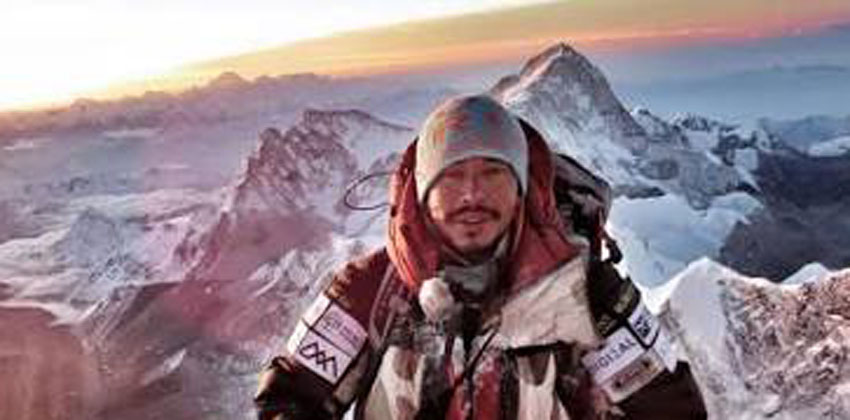
Nirmal Purja (Nims Dai): The Soldier Who Redefined the Limits of Mountaineering
Purja's is one of the very few names in contemporary mountaineering that carries as much heft. Having originally been a Gurkha soldier serving in British special forces, this man discovered climbing quite late in life but he transformed the sport entirely to his leaving. Purja took a ten-year period to redefine the limits of human performance at 8,000 metre level - above - and beyond what was previously thought possible. The journey he undertook started from the modest hill village in western Nepal and went on to the very secretive military units in Britain. From there, he moved on to the most challenging peaks of the world - the ones that have claimed many lives - and ended unfortunately with an accident on the slope of Broad Peak in Pakistan in 2026.
Early Life and the Path Into the Gurkhas
Nirmal Purja was born on the very day of July 25 1983 at Dana. It is a very small village tucked away in the district of Myagdi in Nepal, almost at the foot of the range of Dhaulagiri. He comes from a traditional Magar family and has been described as one having very little material means; Nirmal himself has said the family's living quarters were so small, that chickens were kept upstairs in the building, and getting a road would take four days on foot. Very early on he and the rest of his family moved the home from the villages to Chitwan, a district situated in southern Terai region of Nepal that had good kickboxing facilities and was very much the training center for him. Purja's enlistment into the army was, for all practical purposes of the army being the family tradition, an inheritance from his parent's side. He grew up with the hope of becoming an officer and joined his father's path, because in the family of four men who were his brothers only one younger brother was left at that time to the family.
Military allowance that his brothers received from the army allowed his education at a bilingual English medium school for boarding students. It is the sort of experience that helped his work later which was split between two countries. Purja joined the Brigade of Gurkhas in the ranks of the British Army in 2003, at merely eighteen years old. He has claimed that after completing the basic training course at the Infantry Training Centre Catterick he became the top soldier of the batch, and from there on he was Queen's Gurkhas Engineers member.
Six years of Gurkha service had been the prelude to the next phase of his life. In the autumn of 2009, Purja became the first Gurkha to make it through the famously exacting selection course for Special Boat Service of the Royal Navy. It was Actually a remarkable achievement considering that before that time, the unit did not accept Gurkhas as members. For about ten years, he became proficient in the art of cold-weather warfare and was posted in Afghanistan. At the same time, he pursued his academic interests through courses and eventually earned a postgraduate diploma in security and risk management from Loughborough University. In a very understated and indirect way, these life experiences were the things that quietly enabled him to face a very different kind of hardship one year later when he decided to pursue high-altitude mountaineering as a sport. Purja's life out of the military was no less important than his career in the army, in the year 2006, he was united in wedlock with Suchi Purja who was also the child of a Gurkha soldier.
Why He Switched to Mountaineering
Purja was quite different from most high-level climbers. He had not even thought about Everest as a child. The mountains were introduced to him nearly accidentally when he went to the Everest Base Camp on leave from his military service. This stay with the mountains changed his life and, in 2016, he became the first Nepalese mountaineer to summit Mount Everest. For the first time, while still in the Army, he stood on top of Everest. The next year, he decided to celebrate the two centuries of the Gurkha service in the British Army by taking thirteen
Gurkha soldiers to the Everest base. In the days after the summit, he ascended Lhotse and Makalu, both over 8,000 metres, in quick succession over a few days. It seems as though these feats hinted at what was coming next.
Purja's military career, together with his mountain sports aspirations, became incompatible. In 2018, after a period of nearly sixteen service years in uniform, Purja gave up his British Army career to fully focus on sport climbing - a choice which entailed exchanging a secure, pensioned and waged life for uncertain revenues from high altitude mountaineering. At the same time, he obtained the MBE (Member of the Order of the British Empire), acknowledging him as the mountaineer who had given an exceptional contribution to climbing. Freed from his soldiering days, Purja now set himself a completely uncharted goal about both height and speed: scaling all fourty-four world's 8000 metre-high peaks.
Mountaineering Achievements
Project Possible: 14 Peaks in 6 Months and 6 Days
Determined to test the limits of human capability and inspire the world through his feats, in 2019, Purja set foot on the path of the impossible when he began The goal of "Project Possible" is to ascend all thirteen of the world's eight-thousanders—the only mountains higher than 8,000 meters—in a single push without descending. The former record for completing the challenge of summiting fourteen of the world's eight-thousanders was almost eight years. Purja Still wanted to achieve this feat in just a few months. His team had only two hours of bottled oxygen when they went above 7,500 m. In a video interview, Purja said this was the least he could do if he wanted to be physically able to assist other climbers in distress after he himself had been in such a situation many times during past expeditions.
From April to October 2019, Purja summited all fourteen mountains over 8,000 m within six months and six days, breaking the record of nearly eight years by about seven years. He gained worldwide recognition for his effort, which afterwards was the subject of the Netflix film "14 Peaks: Nothing Is Impossible" (2021) that first exposed his story to a global audience much wider than just the mountaineering circle and also highlighted both the physical sacrifices that Purja had made and the enormous logistical challenges that the expedition had entailed." Fast, but for Purja it was never just speed.
He continued to climb all fourteen eight-thousanders a second time and this time without bottled oxygen which he had used during the first climb. That decision was a direct response to some detractors who said he relied on bottled oxygen. As a result, he proved himself to be a rare mountain climber who could handle very high altitudes without additional oxygen and be absolutely safe both for oneself and for other people. This way, Purja further solidified his reputation as one of the most well-rounded high-altitude climbers of his generation.
First Winter Ascent of K2
On January 16 2021 Purja achieved a great honor in modern mountaineering by joining the group of climbers who did the first-ever winter ascent of K2. K2 is the world's second-highest peak and, back then, was the only 8,000-meter peak that had not yet been winter-scaled. Purja and nine other Nepali mountaineers - Mingma Gyalje Sherpa, Gelje Sherpa, Mingma David Sherpa, Mingma Tenzi Sherpa, Dawa Temba Sherpa, Pem Chiri Sherpa, Kilu Pemba Sherpa, Dawa Tenjing Sherpa, and Sona Sherpa - were very strategic. They made up a last group near the top just to reach the peak simultaneously, the moment they stepped onto the summit, and sang their national anthem, Nepal Rashtra Gan.
If anyone has the power of breathing the oxygen that is available at sea-level at that altitude, it will be a superhuman feat. It should be said that Purja was the only summiteer who succeeded without resorting to artificial oxygen support. K2 is known not only because it is a tall peak but also that the conditions there in winter are pretty tough and have earned K2 a local name, "Savage Mountain". Aside from that, the entire climbing team was comprised of Nepali mountaineers, making this accomplishment even more remarkable. That is, Nepali high-altitude mountaineers have long played a decisive role in Himalayan expeditions, yet were not always given the due recognition.
Speed Records and Multiple Summits
In the periods that came after Project Possible, it became clear to many that Purja was not going to slow down for him he had already made history. Between May 15 and 28 2022 he became the first human ever to climb Mount Everest and Lhotse twice during a single climbing season. Before that, between May 7 and 16 of the sameyear 2022, Purja performed a "triple header", that is, he climbed Kanchenjunga, Everest, and Lhotse all within a time frame of eight days, twenty-three hours, and eleven minutes, using only the oxygen available in the air, no supplementary oxygen was used.
Globally, in the world of mountaineering, Guinness World Records have, among other things, awarded him with multiple high-altitude records. By the year 2026, he was said to have climbed 57 of the eight-thousand-meter peaks successfully, with his aim to reach all 14 twice making him the first person ever to do that. Purja was not an easy record holder for the world; in April 2025 the Norwegian climber Kristin Harila did a faster one, she climbed all fourteen of the eight-thousand-metre mountains in 92 days, an example of Really Purja's 2019 achievement had completely changed the level of climbers' belief in what is possible, even though it was eventually surpassed.
Rescues and Recognition
Besides setting the records, Purja's mountain experience was also a source of saving other people's lives. During his expedition in Project Possible, he stopped his descent of Annapurna and rescued another mountain climber. The climber had been stuck in very high altitude for 2 days with no food, water or oxygen and was reportedly being hoisted up on a long rope from a helicopter to reach the stranded mountaineer. Over the years, he had participated in other high-altitude rescues. Purja's action of rescuing other climbers is one of his well-known traits in climbing community, even if he is attempting to set a record or not. Last year, he also launched the Nimsdai Foundation, a nonprofit focused on mountain communities and people of Nepal who work in mountainous areas at great heights.
Elite Exped and Life Beyond Records
Record-breaking alone could not cover expenses. Purja raised the funds for Project Possible after sponsors initially rejected the project, supposedly remortgaged his house in the UK and gave up the comfort of a military pension to get his project on the ground. After beating all records and becoming very well known by people all over the world he created his business based on the knowledge he was using. Elite Exped, the first company for high-end expedition guiding by Purja who operated together with two fellow Nepali mountaineer record breakers: Sherpa Mingma David and Gurungs Tea, they offered customized, safety-first guided climbs on the world's tallest mountains, 2019 sees the birth of Elite Exped. Elite Exped's founders highlighted the model of the business - in-house logistics, route-fixing and food supply without third-party reliance and per company statistics have kept 100% summit and safety record on 8,000 meters mountain climbing expeditions with their clients up to 2026.
Besides guiding, Purja's life story is a source of inspiration and beyond. A 2020 book, "Beyond Possible, " by him is a best-seller and recounts his military journey and Project Possible, besides building the Nimsdai brand in its broader sense, for example: merch, shop and skydiving venture, Skydive Nimsdai, Purja kept on being a prominent speaker and a popular ambassador of different brands, all that together with the Netflix documentary, have made him a decorated soldier-turned-climber who is now one of the most visible figures in the arena of adventure sports worldwide. He had a fortune reported in low millions of dollars at the time of his passing away.
The Broad Peak Tragedy
On Wednesday July 30, 2026, around 9:30 AM local time, a catastrophe took place in an international climb on the twelfth highest mountain in the world Broad Peak at 8,051 m. While ten climbers were attempting to reach the summit, they got caught in a landslide between Camp 2 and Camp 3, at an altitude of approximately 6,600 m. All climbers had satellite instruments that recorded their swift slide down the hill. A person in the group named Purja was carried down over 800 m; at least one other climber got to the base camp. The group lost all contact shortly after the avalanche happened.
Together with his own expedition organization called Elite Exped, Purja had included Broad Peak to his 2026 expedition, requesting the mountain via social media for “safe onboarding and landed”. Due to heavy snow, many other expeditions have decided to withdraw from the mission and move out of there. However, Purja and a few other
people are still trying to reach the summit. Among the deceased climbers, there were two partners of Purja from Elite Exped, his friends Gurung and Sherpa, together with the rest of the group from Nepal, the USA, China and other countries of a ten-member international crew.
This event led to one of the biggest and longest-high altitude rescues and recoveries in the history of the Himalayas and Karakoram. Since almost all mountain climbers on the slope were well-equipped with satellite trackers, it was possible to gain an unexpectedly accurate record of the disaster, as the devices continued sending their messages even when the snow stopped moving. Pakistani aviation units made their move at once, and the Alpine Club of Pakistan organized a multinational rescue mission, including teams made of climbers from Nepal, Pakistan, and other countries. Steep and difficult terrain did not allow for evacuation by helicopter and required rescue teams, including some Sherpa climbers who volunteered to help, to manually bring bodies to Camp 1 and further down towards the so-called Japanese Camp. One of the best-known mountaineers in Pakistan, Sirbaz Khan, who was on his twentieth expedition to Broad Peak, also took part in the search operation, even though he lost a climber he treated as a neighbour and a teacher.
Over the days that followed, rescue teams recovered the bodies of the climbers one by one under extremely difficult conditions, with military helicopters ferrying remains to Skardu as weather allowed. Purja’s body was located and confirmed recovered by August 1, 2026. Elite Exped, the company he had co-founded, confirmed his death in a public statement that day, writing that it mourned “not only Nims, but every life lost in this tragedy,” and specifically honouring Gurung and Sherpa as his trusted climbing partners and guides. The Nimsdai Foundation, which he had founded in 2022, separately paid tribute to the impact of his life’s work. In total, all ten climbers caught in the avalanche — including Nadhira Al-Harthy of Oman — lost their lives, in one of the deadliest single incidents in recent 8,000-metre climbing history.
The impact on Purja’s career, and on the wider mountaineering world, is difficult to overstate. At the time of his death, aged 43, he was still one of the most active and accomplished high-altitude climbers alive, reportedly pursuing an unprecedented goal of climbing all fourteen 8,000-metre peaks a second time. His death on Broad Peak closed out a career that had already redefined what was considered achievable in the mountains — and it reopened, once again, difficult conversations within the climbing community about risk, timing, and the pressure to push forward even as conditions on a mountain deteriorate.
A Lasting Legacy
Nirmal Purja’s extraordinary odyssey—from his hometown in Myagdi, which lacked transportation for a long four days, to serving in the Gurkha Brigade and the Special Boat Service—is considered one of the most astounding narratives in mountaineering. He demonstrated that climbing fast and safely at extreme elevations was not contradictory and that the power of his influence should be used for the justice of long-underappreciated Nepali climbers, who deserve recognition for their invaluable contributions to Himalayan expeditions. His achievements will be remembered for years ahead, and the foundation Nimsdai will ensure that his commitment to the mountain communities of Nepal is maintained in the future.