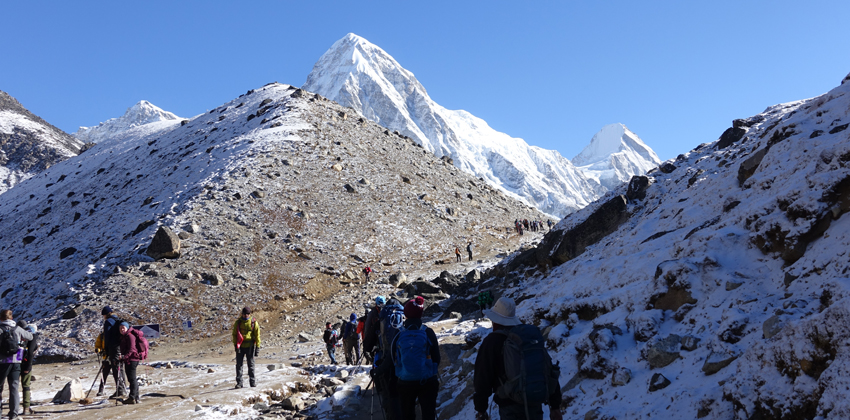
The Great Himalaya Trail Trekking
Trip Overview
-
Duration: 100 Days (95 days of actual trekking)
-
Difficulty: Hard / Technical (requires high fitness and some climbing skills for high passes)
-
Max Altitude: ~6,146m (Sherpani Col / West Col)
-
Start/End: Kathmandu – Taplejung (East) to Hilsa (West)
-
Accommodation: Lodge/Teahouse and Tents
Nepal…Adventure Tourism within new landscapes in the Great Himalayan Trail’s networks…with EncountersNepal.com & the contributions it can make to this great effort.Trekking, History, Nature at its absolute best and a virtual paradise for adventure in Nepal; this is The Great Himalayan Trail {GHT] & EncountersNepal.com seeks to play a vital role in discovering new avenues within the ‘GHT’ trail development for Nepal’s goal in defining greater scopes for Adventure Tourism in the years ahead.
The Great Himalaya Trail is a network of existing wonder treks and tremendous trails which together form one of the longest and highest walking trails in the world.
Amaze of hiking paths beneath the world’s highest peaks and visiting some of the most remote communities on earth, it passes through lush green valleys, arid high plateaus and unbelievable landscapes. Nepal’s GHT is made up of 10 sections comprising a network of upper and lower routes, each offering you something different, be it adventure and exploration, authentic cultural experiences, or simply spectacular Himalayan nature of immense beauty.
The trekking routes in Nepal…many trodden by ‘Encounters Nepal’ while escorting its guests through some of the most rugged territories on earth…
The 1,700 km Nepal section of the trail takes its roots near Kanchenjunga on the eastern border and heads west navigating the domains of eight of the world’s 8000m peaks, from the beautiful but lesser-known Makalu to the famous Everest. It is not the easiest or most direct route across Nepal, but is rather a route through the Greater Himalaya. The Nepal section concludes at Humla on the Tibetan border.
The route offers an incredible diversity in terms of landscapes, flora & fauna, people and culture: from snow leopards to red pandas; from sub-tropical jungle to fragile high-altitude eco-systems; from the famous Sherpas, to Shamanism, to the ancient Bön Buddhist culture found existing till date in Dolpa. It’s a stunning mix within an environment of Mother Nature, animals, diverse communities & the calming divine powers of God.
The National Geographic Adventure Magazine‘s Jame’s Vlahos observes, “Nepal’s mountains are developed to the minimum, but they offer a massive wealth of trade and pilgrimage routes. The GHT elegantly connects these existing paths without blazing a single new trail.”
The Nepal section is part of a longer alpine adventure traversing the spine of the Himalaya from Bhutan to Pakistan. These sections are currently being researched, trekked and documented & Encounters Nepal will play its role to the hilt in finding more routes as there is still a lot of Great Himalaya Trail exploring yet to be done!
EncountersNepal.com seeks to make a difference
Nepal is a poor country and tourism contributes an important 4% of GDP. However, this is seemingly more concentrated, as far as trekking is concerned, in the 3 most popular areas of Solo Khumbu (Everest) region, the Annapurna region and Langtang. These regions are so far deemed to be used the most.
By trekking off the beaten track, you will making a direct difference to communities in these areas by spending money on food, accommodation or services such as guides, porters and cooks. And you’ll be venturing into some of the most incredible places on earth, meeting people following ancient cultures and experiencing unique discoveries that may change your life forever.
Many people from around the world come to Nepal to get away from the crowds and to seek challenge and adventure, and equally vibrant nature or solitude from the dregs of materialism. That is more than possible in Nepal & EncountersNepal.com ensures that its guests get the most out of holidays that gratify the expenses they incur within eco-friendly environments that bring more zest & zeal to the time they spend in Nepal.
Few will have the time to attempt the whole arduous trekking routes, so it is broken up into sections and short treks along the trail. There are many more places to visit in Nepal than just Annapurna, Everest or Langtang, beautiful as they are! Take Dolpa, Rara or Jumla for instance…
Not many people have hiked the length of the Himalayas in the last few decades (and written about it). However, there have been some expeditions with the goal either of traversing Nepal or going further trying to traverse the greater Himalaya range. Adventure enthusiasts are constantly seeking new terrain with newer landscapes less used by others.
In 1982, Arlene Blum and travel and adventure writer Hugh Swift became the first westerners to complete a 4,500 km great Himalayan traverse across Bhutan, Nepal and India. Starting from the eastern border of Bhutan, Swift and Blum, climbed up and down the Himalayan range over 6,000m passes and down to river valleys at 600m, gaining and losing an average of 1,000m each day to reach Ladakh. This is documented in her book – ‘Breaking Trail’. This is evidence of how eager people can be to discover the unknown from the known; & this is where Encounters Nepal wishes to meet & enlighten the aspirations of such ardent adventure seekers by accompanying the bold & brave through some of the most remote outpost on the planet, helping them to achieve dreams hesitantly expected. There are almost countless villages that can be connected; the Himalayas are immensely vast & options are so many…there is a trail for everyone, virtually!
Before embarking on any mountain adventure, Encounters Nepal suggests you should carefully research your trail options and check that you have all the field-craft and experience necessary to attempt the route to wish to hike through. We always encourage volunteers to research new and existing trails throughout the Himalaya, if that sounds exciting then please contact us! We’d be glad to help you.As we continue to be a part of the overall GHT concept, an ever-expanding group of organisations and individuals have come together to help support the GHT and give feedback benefits to those who rely on the Himalaya for their livelihood and home.
EncountersNepal.com has developed Codes of Conduct for trekkers and those who seek a tryst in the wild to promote sustainable and responsible activities. You can support the GHT Alliance through promoting the Codes of Conduct, by providing financial support for a GHT Alliance program and by joining treks run by GHT Alliance partners.
We have worked with & supported trekkers for years; we hope you go through our website & find it useful in serving your holidays dreams!
Enrich your Happiness by enjoying the trails with EncountersNepal.com! Serving you is a way of life for us down here…
Phase 1: The Eastern Frontier (Days 1–17)
The journey starts far from the crowds in the Kanchenjunga region.
-
The Experience: You’ll transition from the humid lowlands into deep, moss-covered rhododendron forests.
-
The Vibe: It feels like stepping back in time. In villages like Ghunsa, you’ll experience the raw, authentic hospitality of the mountains. Crossing Nango La is your first real test—a quiet, high-altitude introduction to the isolation that makes the GHT so special.
Phase 2: Into the Wilds of Makalu (Days 18–30)
This is where the trail gets seriously remote.
-
The Experience: Crossing the Lumbasumba Pass is a major milestone—it’s the bridge between the Kanchenjunga and Makalu regions.
-
The Vibe: You’ll walk through the Arun Valley, one of the deepest in the world, where the biodiversity is incredible. Reaching Makalu Base Camp feels like entering a cathedral of granite and ice, dominated by the fifth-highest peak on Earth.
Phase 3: The Technical Heart (Days 31–50)
Prepare yourself—this is the most demanding part of the entire trek.
-
The Experience: You’ll tackle the "Three Cols." These aren't just paths; they are high-altitude glacial crossings (over 6,000m) that require ropes, crampons, and nerves of steel.
-
The Vibe: After the technical intensity of the Sherpani Col, the familiar sights of the Everest region (Khumbu) will feel like a homecoming. You’ll cross the famous Cho La and Renjo La passes before taking on the legendary Tashi Labsta, a rugged gateway into the mystical Rolwaling Valley.
Phase 4: Cultural Hidden Gems (Days 51–67)
The pace changes slightly as you enter the Langtang and Ganesh Himal areas.
-
The Experience: After the icy passes, the Ruby Valley feels like an emerald paradise. You’ll walk through Tamang and Gurung villages where the culture is as vibrant as the scenery.
-
The Vibe: This section is about the people. It’s the smell of woodsmoke, the taste of local butter tea, and the rhythm of village life that hasn't changed for centuries.
Phase 5: The Classics Reimagined (Days 68–82)
You’ll now traverse the famous Manaslu and Annapurna circuits, but with a GHT twist.
-
The Experience: Crossing the Larke La and Thorong La passes are iconic achievements.
-
The Vibe: While these areas are more popular, seeing them as part of a 100-day journey gives you a unique perspective. You’re not just a tourist passing through; you’re a nomad who has walked from the other side of the country.
Phase 6: The Great Western Silence (Days 83–120)
The final stretch takes you into the most mysterious part of Nepal: Dolpo and Humla.
-
The Experience: This is "Snow Leopard" country. You’ll see the surreal, turquoise waters of Phoksundo Lake and trek through the high-altitude deserts of Upper Mugu.
-
The Vibe: It is hauntingly beautiful and incredibly quiet. By the time you reach the Tibet border at Hilsa, you will be a different person than the one who started in the east.
What does it take?
This isn't a "vacation" in the traditional sense—it's an achievement.
-
The Mental Game: You need more than just strong legs; you need a resilient spirit to handle 100 days of basic living and physical exertion.
-
The Technical Edge: You don't need to be a pro climber, but you should be comfortable with basic mountaineering gear for the high passes.
-
The Reward: You will be one of a very small group of humans to have ever seen the entire Nepalese Himalaya on foot.