Trek Nepal. Feel Alive.
At 5,545 metres above sea level, your lungs work twice as hard for half the air. Your legs ache. Your lips are cracked. Yet, you will be grinning as you've never grinned in your life. It's 4:17 am on Kala Patthar, and right as the sun hits the summit of Everest and turns it gold, every hard step that got you here becomes completely, utterly worth it. Perhaps the best view of the towering Everest without climbing it.
Everest Base Camp is not the most beautiful place you'll reach on this trek. It's not even close. And that's exactly what makes it unforgettable. This 16-day itinerary gives you the best: two nights in Kathmandu, a flight to Lukla, and two dedicated acclimatisation days (Namche Bazaar and Dingboche). The maximum altitude is not Base Camp at 5,364m but Kala Patthar at 5,545m, on a ridge of Pumori that happens to offer the most iconic view of Everest on earth. And rest assured, you will stay for a safety buffer in Kathmandu before your international flight.
The mountains are waiting, but the city insists on going first.
You land at Tribhuvan International Airport, and Nepal hits you immediately: the heat with cool breeze, the colour, the noise and the smell of marigold garlands. Kathmandu doesn't ease you in; it swallows you whole.Encounters Nepal will then transfer you to the hotel, and the evening opens with a Welcome Dinner and a live Nepali cultural show. Sit around the music of madal drums played.
Four UNESCO Sites in One Day
The city gives you one full day before the mountains, and the itinerary uses it brilliantly: four UNESCO World Heritage Sites- Pashupatinath, Boudhanath, Swayambhunath, and Kathmandu Durbar Square, in a single circuit. You can find more about the travel by clicking here.
Swayambhunath is perched on a hill above the city. Climb the 365 steps for your first panoramic view of the Kathmandu Valley and your first real lungful of high-altitude thinking. Be careful of the hungry monkeys scouting the area.
Kathmandu Durbar Square used to be the old royal palace complex. You might as well get a view of the only living goddess, Kumari. No photos tho!
Boudhanath is one of the largest Buddhist stupas in the world. Walk clockwise around it, spinning the prayer wheels. The eyes painted on the four sides of the spire are watching in every direction, guarded by the all-seeing wisdom of the Buddha.
Pashupatinath is the most sacred Hindu temple in Nepal, on the banks of the Bagmati River. Enlightening aratis and cremation ghats burn in the open air. This makes the evening confronting and deeply human. Don't look away.
The night dawns slowly. Your lead guide briefs you on the trek. Pay attention. This person knows these mountains better than any guidebook
The Runway That Ends at a Cliff
The first day of actual trekking is gentle, which feels almost insulting given what's coming. From Lukla, you follow the Dudh Koshi River, downhill through pine forest to the village of Phakding at 2,630 metres, lower than where you started. This is deliberate. The body's adjustment to altitude begins with going down, which feels counterintuitive until you understand that what matters is where you sleep, not how high you walk during the day. That principle runs through the entire itinerary like a spine.
The Khumbu Opens Its Doors
The trail into Namche Bazaar the following day is where the Khumbu starts to reveal its character. You pass through the entrance to Sagarmatha National Park at Monjo, cross suspension bridges swaying above the river gorge, and on your first crossing you'll grip the cables; by your last you'll cross barely looking down, and then climb steeply for two hours through forest until the trail rounds a corner and there it is: the Sherpa capital, 3,440 metres up, cupped in a natural amphitheatre of hillside with coloured houses terraced up the slopes like a stadium facing the mountains. The Saturday market here has been running for centuries.
Slow Down or the Mountain Will Slow You Down
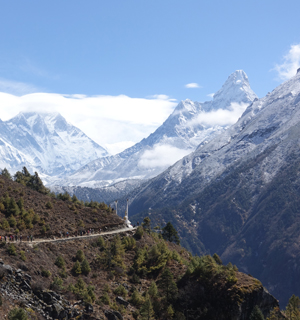
You spend two nights in Namche, and the day between them matters more than the day you arrive. The itinerary sends you up to the Everest View Hotel at 3,880 metres, your first proper sighting of Everest, a dark triangular summit above the Nuptse ridge, flanked by Lhotse and the improbably elegant pyramid of Ama Dablam.
The worthwhile detour is continuing to Khumjung village to see the Hillary School, one of dozens of schools and medical posts built across the Khumbu by Sir Edmund Hillary's Himalayan Trust starting in the 1960s. The school still runs.
The Monastery That Burned and Came Back
The path from Namche to Tengboche is arguably the most beautiful stretch of trail. Ama Dablam appears and disappears between the trees. The Tengboche monastery sits at a ridge at 3,867 metres with Everest, Lhotse, and Nuptse arranged behind it in a way that looks completely staged. The afternoon prayer ceremony inside: low horns, butter lamps, monks in red robes, the cold light through the windows, is one of those things that stays with you well after the photographs have stopped meaning much.
What most people don't know is that the monastery burned to the ground in 1989, an electrical fire that destroyed almost everything. The rebuilt gompa now has a hydro-electric generator, the same technology that caused the fire, managed more carefully.
Thin Air Starts Here
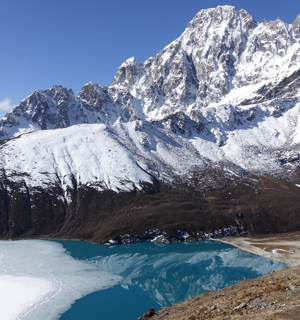
Above Tengboche, the landscape changes in a way that's difficult to prepare for. The trees thin out, then disappear. The trail crosses above the treeline into open moorland, then into the stark high-altitude terrain of the upper Khumbu, grey rock, white snow, sky that seems larger than it should be.Dingboche sits at 4,410 metres in a wide valley, and the air there is noticeably thinner in a way that's hard to articulate. Sleep becomes lighter. Appetite drops. A persistent low-level headache that ibuprofen takes the edge off but doesn't quite cure. This is all normal, and the second acclimatisation day is the answer to it. Our itinerary sends you up to Nagarjun Hill at 5,100 metres, high enough to see Makalu, the world's fifth-highest peak, and the Island Peak valley, then back down to sleep at 4,410. That rhythm, climb high and sleep low, is how your body learns to cope. It's not optional.
Walk Slower. Read the Names.
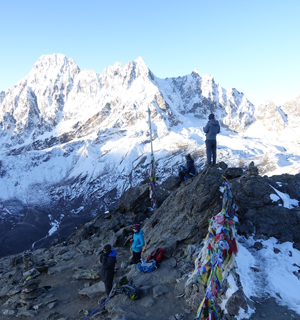
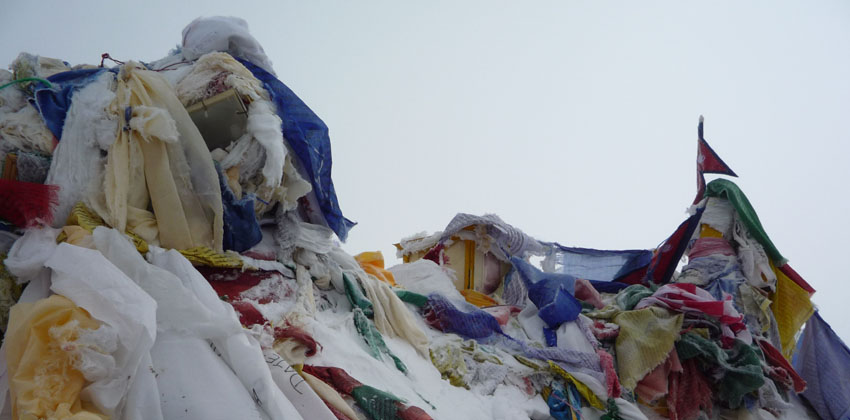
The Thukla Pass between Dingboche and Lobuche is where the trek becomes something more than a very long walk. At the top of the pass, there's a plateau scattered with stone cairns, each one built for a climber who didn't come back from the mountains above. Scott Fischer. Rob Hall. Anatoli Boukreev. Their names are carved into the rock, and the wind comes across the plateau with nothing to stop it. Most people spend five minutes here. It deserves more than that. The mountain you're walking toward took these people, people who were extraordinarily skilled and experienced, and the memorial is the most honest thing the whole trail has to offer about what the high Himalaya actually is.
From Thukla, the path follows the moraine of the Khumbu Glacier down to Lobuche at 4,930 metres. The glacier itself looks nothing like the blue-ice images you've probably seen. It's a river of broken rock and rubble that moves roughly a metre a day, slow enough that you could watch it for an hour and see nothing. That movement is worth holding onto later, because Everest Base Camp sits on top of this glacier, which means the camp shifts position slightly every year. There is no fixed GPS coordinate that is Base Camp. Every expedition sets up camp in a slightly different physical location as the glacier flows beneath them.
Standing at the Foot of Everything
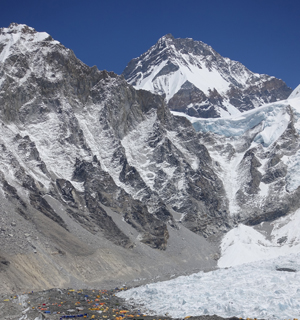
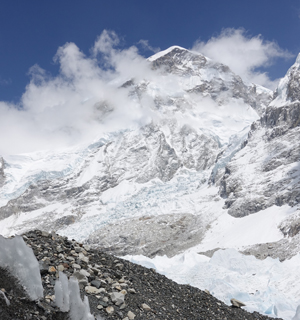
Base Camp itself is, honestly, not what most people expect. It's a boulder field. Rubble and orange tents and prayer flags if you're there during expedition season, just rubble and prayer flags if you're not. Everest's summit is invisible from here, hidden behind the Nuptse ridge. What you get instead is the Khumbu Icefall directly above you, which is a collapsed, groaning mass of ice seracs and crevasses that every summit climber must pass through, and that has killed more people on Everest than any other section of the mountain.
It makes sounds. Deep, occasional sounds that you feel more than hear. Standing at 5,364 metres looking up at it, knowing that every climber who has ever stood on Everest's summit started here, walked through that, is a specific kind of feeling that doesn't have a clean name.
Early to sunrise
The Kala Patthar sunrise on the following morning is the other thing. You wake at 3:45 am, dress in everything you own, and walk uphill in the dark at 5,000-plus metres by headlamp. The cold before dawn at that altitude is its own category of cold. At the top of the ridge, 5,545 metres, you wait. Then the sun catches the summit pyramid of Everest, just the summit, everything else still dark, and turns it gold. Then the colour spreads down across Lhotse and Nuptse, and the whole extraordinary range is laid out in front of you.Kala Patthar is technically not an independent mountain but a spur of Pumori, a 7,161-metre peak behind you. Yet its angle produces the clearest, most frontal view of Everest that exists anywhere accessible to trekkers. The summit itself is more distant and obscured from Base Camp. Almost nobody tells you this before you go.
Decent descent
The descent from Kala Patthar back toward Pangboche and eventually Lukla retraces the route, and the mountains look genuinely different from the other direction; steeper from the south, the proportions of the valley have changed. Your body feels different, too. Below 4,000 metres, the air thickens, and appetite comes back with an aggression that's almost funny. You eat enormous amounts of dal bhat and apple pie in Namche teahouses and feel completely fine about it.The last night in Lukla is the night you celebrate with the guides and porters, the people who carried your bags and kept you on route and cooked in conditions that would have stopped most professional chefs. A porter on this route carries 25 to 30 kilograms. On trails that you found challenging with a 10-kilogram daypack. They're also among the most under-credited workers in the trekking industry, and tipping well is not optional etiquette; it's basic fairness.
The Mountain Lets You Go
Then the terrifying little runway again, the cliff edge, the small plane banking over the valley. Then Kathmandu, then eventually home, with photographs on your phone that will never quite capture the light and legs that will feel different for a while and the particular, quiet satisfaction of having walked somewhere that genuinely required something of you.
You came looking for a mountain and found out something about yourself instead. That's the oldest trade in the Himalaya, and nobody ever walks away feeling cheated.