The alarm goes off at 5 a.m. It's still dark outside. Kathmandu is quiet. But you're wide awake, because today, you're going to see Mount Everest. Not from a photo or a documentary. From a plane window, close enough to touch, or so it feels.
This is the Everest mountain flight. One hour. No hiking boots. No sore legs. Just you, a window seat, and the tallest mountains on Earth.
“Because it's there,” George Mallory famously said when asked why he wanted to climb Everest. You don't need his answer to feel his pull. You just need a seat on this flight.
A past passenger once described it simply: “Everest appeared, a great pyramid jutting into the sky, its peak brushed by a single wisp of cloud.” That's the moment everyone comes for, and it happens right outside your window.
Why Fly Instead of Trek?
Let's be honest. The Everest Base Camp trek is epic but also brutal. Eight hours of hiking a day on steep trails and thin air. You’re weeks away from home.
Not everyone has that kind of time or that kind of stamina. Well, that's okay, and we have you covered.
The mountain flight gives you the same jaw-dropping view in a single hour. You get to see the giants of the Himalaya without a single blister. Photographers, grandparents, honeymooners, kids on school holiday—everyone fits on this flight.
And here's the truth nobody tells you: even hardcore trekkers who spend three weeks walking to Base Camp never actually see Everest's summit up close from the ground. Big shoulders of rock and neighbouring peaks block the view. From the flight, there's no blocking but just sky, snow, and Sagarmatha in full glory.
What Happens on the Morning of the Flight
Mountain weather doesn't wait for late risers. A car picks you up from your hotel. You head to the domestic terminal of Kathmandu's airport, half asleep, coffee in hand. Check-in is quick. Every passenger gets a guaranteed window seat, so nobody gets stuck staring at a seatback.
Then you board. The propellers spin. The plane lifts off the runway, and Kathmandu Valley shrinks below you into a patchwork of terraced fields and red rooftops.
Within minutes, everything changes.
The Moment the Mountains Appear
First, you catch sight of Shishapangma, its long white ridge sitting right on the Nepal-Tibet border. It's the only 8,000-metre peak entirely inside Tibet, and legend ties it to Hindu mythology. Gosainthan, from the Sanskrit meaning “Holy Place” or “Abode of God”, is closely linked with Shiva himself.
Then Dorje Lakpa rises into view, a peak whose name in Tibetan roughly translates to a lightning-thunderbolt deity. Locals say it looks like a giant number eight lying on its side, wrapped in snow.
Next comes Gauri Shankar, a peak considered so sacred that climbers weren't even allowed to attempt it until 1979. Sacred and stubborn, much like Choba Bhamare nearby, a smaller peak that, to this day, has never been climbed by anyone.
Langtang Lirung appears too, standing guard over the Langtang Valley, a valley so beautiful that trekkers who've seen it often call it Nepal's best-kept secret. You won't see the valley itself from the plane, but you'll see its guardian peak in full detail.
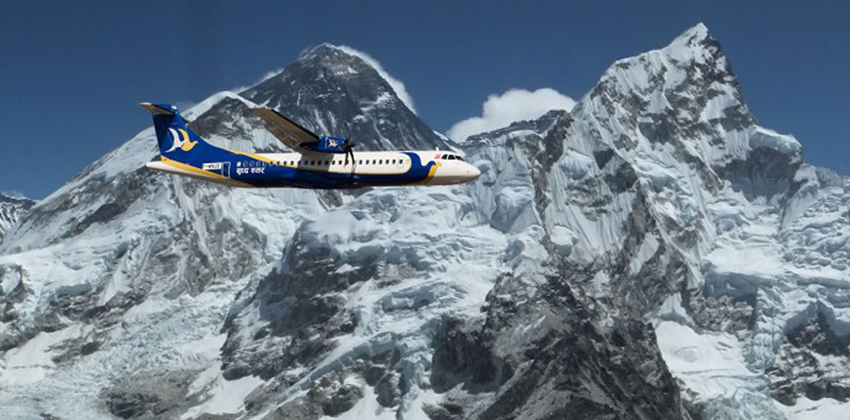
And then, there it is. Everest.
You don't need anyone to point it out. It simply looks different from everything around it. Taller. Sharper. Wrapped, more often than not, in a thin plume of cloud streaming off its summit like a flag. That plume has snow being blasted sideways by jet-stream winds that can hit 200 miles an hour at the top.
Sir Edmund Hillary and Tenzing Norgay Sherpa first stood on that summit in 1953. Fun fact: their climb was announced to the world on the very morning of Queen Elizabeth II's coronation, making it feel like a gift fit for royalty.
Locally, Everest carries two other names, each just as powerful. Nepalis call it Sagarmatha, “Forehead of the Sky.” Tibetans call it Chomolungma, “Mother Goddess of the World.” Both names capture something a number never could. Everest isn't just the highest point on Earth at 8,848 meters. It's a presence.
The Cockpit Moment
Here's the part passengers talk about for years after. Partway through the flight, the crew invites you, one at a time, into the cockpit. For a few short minutes, you get an uninterrupted, windshield-wide view of Everest and its neighbours, no window frame in the way.
Photographers, take note. This is your money shot. The cockpit view is wider, cleaner, and unforgettable. Camera ready. Steady hands. This is the moment.
Beyond Everest, the plane usually reveals its towering neighbours too–Lhotse, the world's fourth-highest peak, meaning “South Peak” in the Sherpa language because it sits just beside Everest's shoulder. Nuptse stands close by, along with the elegant, fishtail-like ridges of Ama Dablam, often called one of the most beautiful mountains on the planet, even though it doesn't crack the world's top ten in height.
Further along, Makalu comes into view, a sharp, four-sided pyramid rising to 8,463 meters, and Cho Oyu, the sixth-highest mountain on Earth, whose name means “Turquoise Goddess.” On a clear day, the flight may also stretch toward Kanchenjunga in the far east, the world's third-highest peak, straddling the border between Nepal and India.
In under an hour, you'll have set eyes on more than 8,000-metre giants than most mountaineers see in a lifetime.
Fascinating Facts to Impress Your Friends
Everest grows. Slowly, but it does. The tectonic plates push it upward by about 4 millimetres every year.
Commercial jets normally avoid flying directly over the Himalaya. The altitude, unpredictable winds, and thin air make it risky, even for planes that can technically climb to 30,000 feet.
Three teams in history have paraglided off Everest. The first was French climber and pilot Jean-Marc Boivin, back in 1988.
Why This Flight Feels So Alive
There's a particular kind of silence that falls over the cabin the moment Everest comes into view. Not boredom. Not sleepiness. Awe. Grown adults go quiet. Cameras click nonstop. Someone always gasps.
That's the thrill of it. You're not reading about the roof of the world. You're floating right beside it. Eye to eye with a mountain that has swallowed climbers whole and inspired explorers for over a century.
You don't need ropes, oxygen tanks, or three weeks of vacation time. You need one early alarm and a window seat.
The Practical Bits
The flight departs from Kathmandu's domestic terminal, usually between 6 and 8 a.m., before clouds roll in. It lasts about an hour, flown by experienced local airlines that specialise in these scenic routes. A ticket costs roughly USD 240 per person, and you can request either a window or aisle seat, subject to availability, although a window is what everyone wants for obvious reasons.
Best season to fly: the drier, clearer months, when the sky stays sharp, and the peaks stand out crisp against the blue. Cloudy or monsoon days can delay or cancel flights, so mornings and good weather windows matter.
At the end of the flight, many operators hand out a souvenir certificate, proof that you flew face-to-face with the highest point on the planet. It makes a nice thing to frame next to your Everest photos.
So, Did You See Everest?
That question follows every traveller home from Nepal. It's become something of a rite of passage. With the mountain flight, you get to answer with a full, satisfied “yes” plus photos to prove it, without a single day of trekking behind you.
Wake up early. Grab the window seat. Let the Himalaya do the rest.